$15 (one time purchase; NOT a subscription!)
Purchase contains both a Mac and PC version.
FAQ: will this work with color charts? No. Color charts do not produce linear CGATS M0 files, and this software depends on the numbers changing in a linear progression. (ie 1,2,3,4,5,6,7,8,9....99,100)
Will this work with multiple M0 files? Yes. It will check each one at a time. It will not chain them together end-to-end to make one huge file.
Will this work with a linear progressive M0 file of 1000 entries? Probably, but I never tried it.
Will this work on my Royal Doulton china and ink paper airplane? I dunno. It was built to work (and has been tested on) gray-scale progressive (light to dark) patch charts of 128- 256 tones. That is what is generally used for Piezography or other B&W inkjet printing.
If you make your own grayscale curves or profiles by scanning a grayscale chart, you probably want this software.
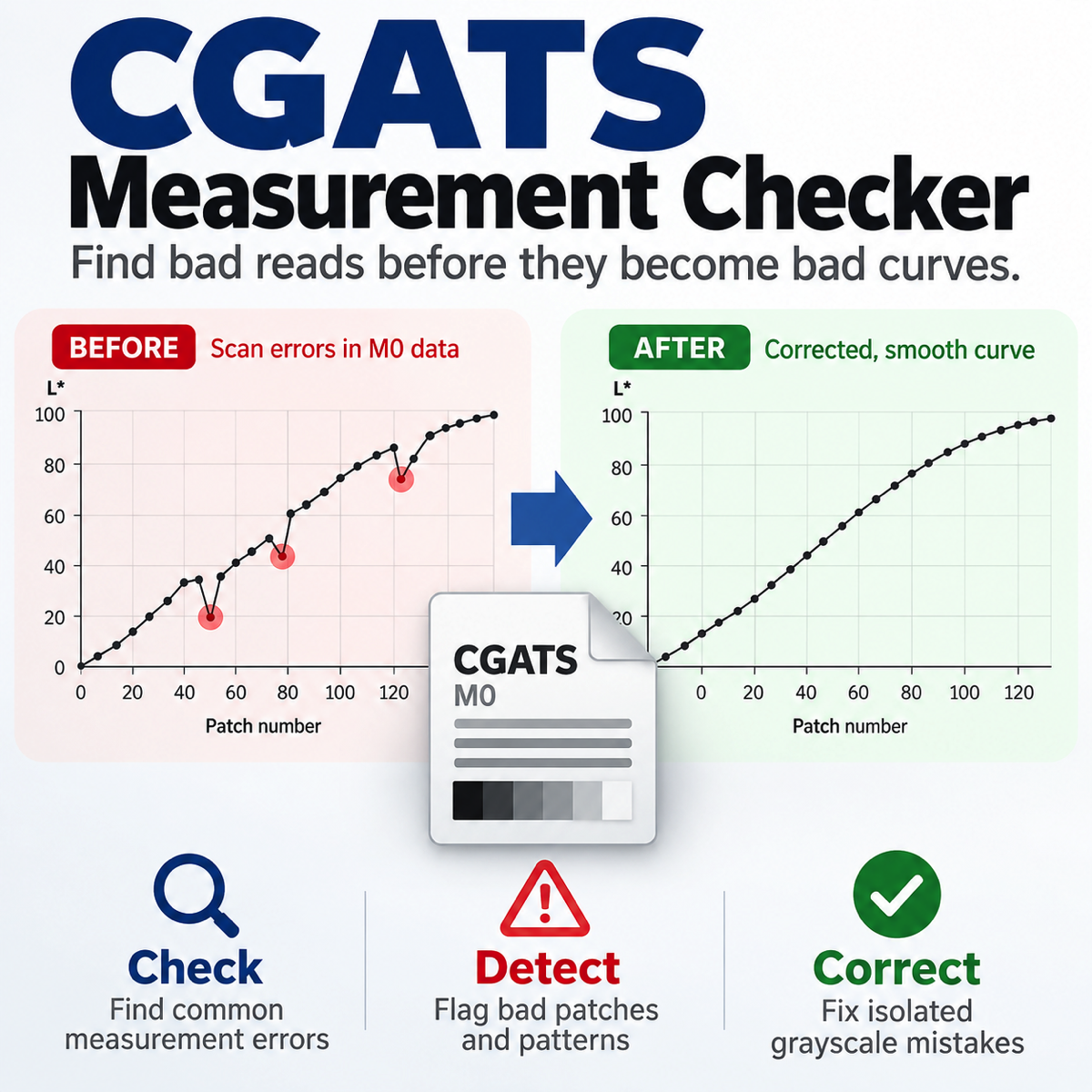
Bad spectrophotometer readings can spoil a grayscale calibration curve. CGATS Measurement Checker (CMC) checks your M0 file for common scan errors and can correct isolated bad readings before you build the curve. CMC saves you having to do this by hand.
This is NOT "smoothing" software! It's a one-trick-pony that will correct the all-too-common scanning errors which result in non-linear readings. For example if you have M0 readings that go 70, 69, 68, 71, 67, 66... that "71" is a reading error and will screw up your curve. This software will find and replace the odd-ball reading with a rational one, thus giving you a linear curve. (In this case it would likely replace the 71 with 67.5.) It isn't 'magic' - it just creates a number that will fit properly. Not necessarily tonally accurate just fitting the curve. If you've been manually reviewing your M0 files for linearity, and have been guessing at replacements for errors, this is simply an automated version that won't overlook anything.
Just drag-n-drop your M0.txt file onto CMC and it will point out problems, and fix them. Click the button to download the correct M0.txt file. Takes < 10 seconds.
CGATS Measurement Checker is a preflight tool for spectrophotometer data. It checks CGATS/i1Profiler measurement files for acquisition errors before those errors get baked into a linearization curve or ICC profile.
It can compare repeated reads patch-by-patch using ΔE00, flag impossible L* reversals in grayscale ramps, detect periodic error patterns that may indicate strip/row/column reading problems, and repair isolated grayscale reversals while preserving the rest of the measurement data.
In practical terms, it answers one question before profiling begins:
“Is this measurement file linear?”
Bad spectrophotometer readings can spoil a grayscale calibration curve. CGATS Measurement Checker (CMC) checks your M0 file for common scan errors and can correct isolated bad readings before you build the curve. CMC saves you having to do this by hand.
This is NOT "smoothing" software! It's a one-trick-pony that will correct the all-too-common scanning errors which result in non-linear readings. For example if you have M0 readings that go 70, 69, 68, 71, 67, 66... that "71" is a reading error and will screw up your curve. This software will find and replace the odd-ball reading with a rational one, thus giving you a linear curve. (In this case it would likely replace the 71 with 67.5.) It isn't 'magic' - it just creates a number that will fit properly. Not necessarily tonally accurate just fitting the curve. If you've been manually reviewing your M0 files for linearity, and have been guessing at replacements for errors, this is simply an automated version that won't overlook anything.
Just drag-n-drop your M0.txt file onto CMC and it will point out problems, and fix them. Click the button to download the correct M0.txt file. Takes < 10 seconds.
CGATS Measurement Checker is a preflight tool for spectrophotometer data. It checks CGATS/i1Profiler measurement files for acquisition errors before those errors get baked into a linearization curve or ICC profile.
It can compare repeated reads patch-by-patch using ΔE00, flag impossible L* reversals in grayscale ramps, detect periodic error patterns that may indicate strip/row/column reading problems, and repair isolated grayscale reversals while preserving the rest of the measurement data.
In practical terms, it answers one question before profiling begins:
“Is this measurement file linear?”